Lenovo Legion Pro 7i Gen 10 (RTX 5080, 64GB) VS MSI Vector 16 HX AI (RTX 5080, 64GB)
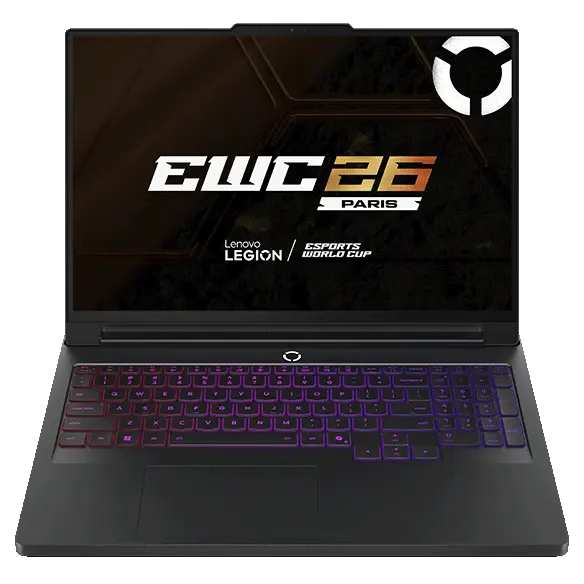
Lenovo Legion Pro 7i Gen 10 (RTX 5080, 64GB)
Live Sync

MSI Vector 16 HX AI (RTX 5080, 64GB)
Live Sync
🤖 The Bottom Line (Hardware Verdict)
The Lenovo Legion Pro 7i Gen 10 and MSI Vector 16 HX AI square off in a high-stakes clash of RTX 5080 powerhouses. While both machines pack identical core silicon and full 175W TGPs, Lenovo commands a $1,079 premium for its enthusiast-grade panel and cooling. MSI counters with an aggressively priced performance chassis that targets maximum frames per dollar.
⚔️ Performance Battle
Under the hood, both machines leverage the Intel Core Ultra 9 275HX alongside a maximum 175W NVIDIA RTX 5080 GPU and 64GB of RAM, complete with hardware MUX switches for direct GPU routing. Raw rasterization frame rates and 1% low FPS in AAA titles are practically identical out of the box, ensuring neither machine bottlenecks this elite GPU tier. However, sustained compute workloads reveal a subtle split: Lenovo's cooling maintains higher sustained boost clocks under simultaneous CPU and GPU loads, whereas MSI's dual-fan thermal setup runs warmer, potentially inducing minor during extended sessions.
🖥️ Display & Visuals
While both laptops drive buttery-smooth 240Hz refresh rates ideal for high-framerate competitive play, the visual experience is night and day due to panel tech. Lenovo features a stunning display that delivers pixel-level dimming, infinite contrast ratios, zero blooming, and sub-millisecond response times for breathtaking HDR gaming. MSI opts for a standard 240Hz IPS panel, which offers respectable color reproduction and wide viewing angles, but completely lacks the deep black levels and vibrant dynamic range of Lenovo's OLED offering.
❄️ Design & Thermals
Lenovo equips the Legion Pro 7i with a high-end vapor chamber thermal module, resulting in lower surface temperatures and quieter acoustic profiles at the cost of a heavier overall chassis footprint. Conversely, MSI utilizes its traditional Cooler Boost dual-fan thermal architecture to keep the Vector 16 HX AI down to a nimble 5.5 lbs. While MSI wins on portability, Lenovo delivers superior build rigidity and acoustic comfort during long gaming marathons.
🏆 The Verdict: MSI Vector 16 HX AI (RTX 5080, 64GB) Wins
At $3,319, the MSI Vector 16 HX AI delivers the exact same 175W RTX 5080 gaming throughput as the $4,398 Lenovo Legion Pro 7i, earning it a significantly higher value score of 3.77 versus Lenovo's 2.84. While Lenovo offers luxury extras like an OLED panel and vapor chamber thermals, paying a $1,079 premium for identical frame rates is hard to justify for most gamers. The MSI Vector 16 HX AI stands out as the decisive winner for price-to-performance dominance.
- ✓
Buy Lenovo Legion Pro 7i Gen 10 (RTX 5080, 64GB) if: You demand the ultimate visual experience with an ultra-fast OLED screen and superior vapor chamber cooling, regardless of price.
- ✓
Buy MSI Vector 16 HX AI (RTX 5080, 64GB) if: You want top-tier 175W RTX 5080 gaming performance and 64GB RAM while saving over $1,000.